About two years ago, I went on a short business trip with a colleague in her Tesla. It was my first time in an EV (electric vehicle), and I was thoroughly impressed. It was quiet, clean, and snappy on takeoff. It was sleek and modern on the inside. It was certainly 'on par' with current gas-powered vehicles and superior in many ways. It also needed no gas or a tail pipe.
While not yet common, the prevalence of EVs is growing and really taking off in less wintry places like California and Florida. The percentage of EV new car sales is increasing, and many car makers and governments are making bold and aggressive commitments to zero-emissions. New models seem to pop up weekly. It feels like we're in the midst of an EV revolution. What impacts will such a profound change have? Are there challenges? When will you purchase your first (or next) electric vehicle?
It's about more than cars.
Two- and three-wheelers: When we think about EVs, we tend to think about four wheels and family transportation, but the EV universe is much bigger than that. Bloomberg reports that combined sales of two and three-wheeled EVs far eclipsed passenger cars, largely driven by sales in Asia where smaller vehicles are more common. It's also predicted that there will be as many as 300 million E-bikes in use in 2023.
Delivery vehicles: In a discussion with Amazon on an episode of Jay Leno's Garage, they were chatting about Amazon's partnership with Rivian which is making custom EV delivery vans for the retailer. It was amazing to hear that, in dense urban areas, an Amazon delivery vehicle puts on less than 100 miles a day, obviating the usual range and recharging concerns.
School buses: There are about half a million school buses in the US and most run on diesel. Many schools are planning to leverage the infrastructure bill to replace aging buses with electric models. Most buses make two runs per day making them a great fit for electrification and recharging, not to mention the benefit of less diesel exhaust in our kids' lungs. For many fleet applications it seems that EVs definitely fall into that 'no brainer' category.
The revolution has its challenges.
EVs run on lithium-ion batteries which is amazing technology but there are some issues. There's a fire risk and most are made with nickel and cobalt that involve mining and supply chain challenges. New battery technologies like LFP (lithium iron phosphate) and many others are on the way, but time is required to ramp up production and shake out the various contenders. We also still don't have a good recycling solution for EV batteries when they need to be replaced. That said, MIT Technology Review listed EV battery recycling as one of its top 10 technologies to watch for 2023.1
Most EVs have a range of about 300 miles, far less than comparable gas-powered vehicles, and gas-powered vehicles can always refuel at numerous locations quickly and efficiently.
We're starting to see more charging stations, but they are sparse, have long charging times, and are not standardized, although some efforts are underway in that regard. You can certainly recharge in your garage overnight, but the away-from-home charging realities often lead to 'range anxiety' limiting the use and adoption of EVs for many tasks. To address these issues, forthcoming battery technology is laser-focused on safety and improved range.
Additionally, while electrification of transportation is flexible and can have many applications, it's simply not suitable for core transportation needs met by airplanes, freight trains and ships. While these modes of transportation still need fossil fuels, there is a 'Hydrogen Council' investigating the use of hydrogen as an alternate solution in these cases. Somewhat ironically, producing green hydrogen at scale still requires lots of electricity.
So, it's really an energy revolution?
While EVs come with many benefits, the major point is to reduce carbon emissions and clean the air. Depending upon location, much of the electric power in the US is still produced by burning fossil fuels, so it's important to tap into renewable sources when possible. This is often challenging given that renewable sources can be intermittent and distributed.
Wide-scale EV adoption is also dependent upon the proliferation of standardized fast-charging stations, which require substantial power infrastructure upgrades at many locations across the country due to the amount and type of electricity required. This infrastructure challenge also applies to neighborhood micro-grids in areas with a high density of garage-charging vehicles. It's telling that right after California's announced 2035 gas ban commitment they had to ask EV owners to hold off on charging to protect the grid and prevent blackouts.
The need for a smart grid.
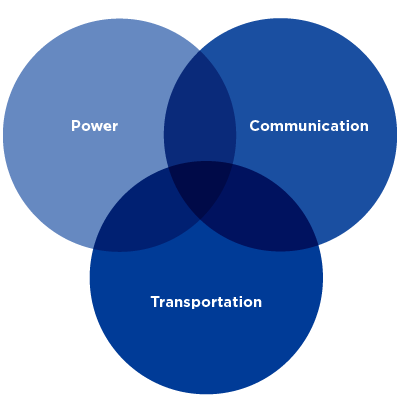
For the coming EV revolution to be successful, a parallel energy grid evolution is required. Often envisioned as a 'smart grid' it contemplates the intersection of transportation, power and communication resources.
Midco is an ardent supporter and data supplier to an organization called Gridmetrics that leverages data networks to provide the type of connected intelligence necessary for the envisioned smart grid, helping to insure that the power to move our vehicles down the road will be there when we need it and will be as renewable as possible.
EV adoption is growing by leaps and bounds, and for good reasons. Many feel that the features of EVs are better than their gasoline counterparts.
Many fleet operations can gain significant cost and maintenance savings, and when combined with renewable sources, daily EV usage produces no emissions. While I think there are some hurdles to jump yet, the EV revolution feels inevitable and will surely reshape our global and personal future in a profound way.